| |
NLP's Four Dimensional Reality
In grade school we were taught three dimensions
of space--height, length and width. In college some of us
learned about Albert Einstein adding a fourth dimension, time.
Indeed, these four dimensions accurately describe physical
objects in space and time. However, the four space-time dimensions
say nothing about the meaning, interpretation and value that
we give to objects and people when we perceive them. To describe
our emotional, intellectual and spiritual experiences we must
rely on neurolinguistics programming (NLP) to define our four-dimensional
world:
NLP's Four Dimensional
Reality
- What we see with our visual representational
system,
- What we hear with our auditory representational
system,
- What we feel with our kinesthetic representational
system,
- The time in which the above representations
occur.
As with any other physical object, the
human body has height, length and width. Based upon the flow
of auditory, visual and kinesthetic information through the
human nervous system, we can assign a traditional dimension
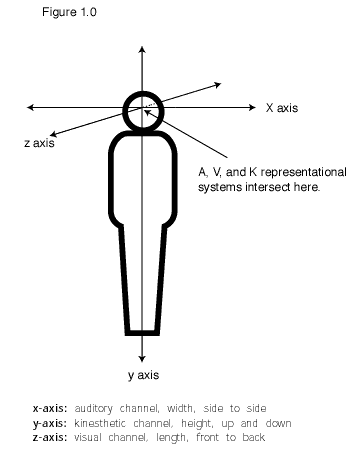
to each of the three primary NLP systems. According to neurological
research, kinesthetic information flows up and down. Hence,
the kinesthetic system corresponds to height. Auditory information
flows side to side; therefore, the auditory system provides
length. Visual information is width since pictures move from
front to back (Figure 1.0). Please note in Figure 1.0, the
auditory line passes through the ears; the kinesthetic line,
the spine; the visual line, the eyes. It just makes good sense
that the auditory system's sound line passes through the ears,
the visual system's sight line passes through the eyes, and
the kinesthetic system's movement line passes through the
spine. Each NLP system also has an axis that appears on a
graph. Namely, the auditory system is the x-axis, the kinesthetic
system is the y-axis, and the visual system is the z-axis.
For these reasons, the name of this article is "NLP as Simple
as XYZ."
A, V and K Meridian Lines
We must always invest some physical and
emotional energy when we form auditory, visual and kinesthetic
representations. The energy of our three primary representational
systems forms meridians. According to the dictionary, "Meridians
are pathways in which energy is said to flow." For example,
in acupuncture the energies of the bladder, kidneys and lungs
are not localized in those organs. The bladder, kidney and
lung each have there own meridians in which energy circulates
throughout the entire body. As with acupuncture, in NLP the
flow of information and energy produces auditory, visual and
kinesthetic meridians as shown in Figure 1.0.
The auditory, visual and kinesthetic meridians obey the basic
conservation of matter and energy laws. As sense data flows
through each representational system, our physical body's
matter and energy are transformed. This explains why we physically
and emotionally feel better once we change our perceptions.
When we alter our reality, we literally change the matter
and energy of our bodies. The auditory, visual and kinesthetic
lines all meet inside the head in Figure 1.0. This is the
place where the representational systems exchange information
with each other. For example, the kinesthetic system takes
the pictures of the visual system and turns them into feelings.
Another example is the auditory system which takes the feelings
of the kinesthetic system and changes them into sounds. Richard
Bandler and John Grinder became aware of the intersection
of representational systems while studying the patterns of
Milton Erickson. They said Erickson helps people by "… using
a lead representational system to develop another representational
system by finding a point of overlap or intersection between
the two." The three meridian lines in Figure 1.0 go a long
way in explaining the intersection of our representational
systems.

Practical Applications
Moving the representational system's meridian
lines is the quickest and easiest way to facilitate change.
First, you must locate your meridians. To find your visual
meridian, see a picture; your auditory meridian, hear a sound;
your kinesthetic meridian, feel a sensation or emotion. Instead
of your imagination, you can use actual sense data (sights,
sounds and feelings) to find your representational meridian
lines. After locating my meridians, I found it was in my best
interest to shift my auditory and kinesthetic lines. I find
unpleasant sounds much less annoying and distracting since
I lowered my auditory meridian from my head to my heart level.
I also realized my kinesthetic meridian was flowing behind
my lower back. I have since moved my kinesthetic meridian
to the center of my abdominal cavity, and as a result, I feel
physically and emotionally better.
The three representational meridian lines have been shifted
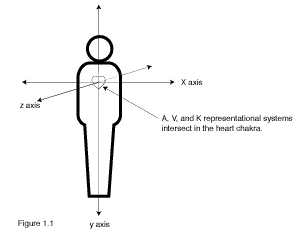
in Figures 1.1 and 1.2. In Figure 1.1, the auditory, visual
and kinesthetic meridians all intersect in the heart instead
of the head. This intersection of representational meridians
through the heart allows the heart chakra to dominate the
senses. This means all three systems--visual, auditory and
kinesthetic--are greatly influenced by the love of the heart
chakra. This intersection is helpful for problems with anger,
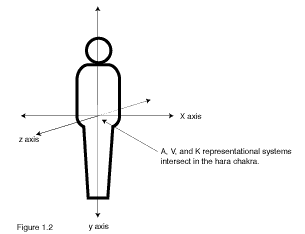
mistrust and resentment. In Figure 1.2, the representational
meridians intersect just below the navel, or what the Japanese
call the "hara," the center of the body. The focus of this
chakra is physical and material health. Here, the intersection
of the meridian lines increases the chakras' energy, which
helps release fear, negativity and worry and improves digestion.
Figures 1.1 and 1.2 are just a small sample of how you can
transform yourself by changing the position of your representational
meridian lines. I highly recommend intermittently realigning
your representational lines. The adjustment of your meridian
lines is similar to a chiropractor's adjustment. Return visits
to a chiropractor are necessary when the spine loses its adjustment.
As with the spine, periodic readjustments of representational
meridians often become necessary.
Intensification is another way to put your representational
meridian lines to work. During intensification, sensory awareness
and intellectual and emotional energy increase, which makes
for a more thorough gestalt experience. To intensify your
perceptions, observe your sights, sounds or feelings along
their appropriate axes. Hear sounds along the x-axis, feelings
along the y-axis, and pictures along z-axis. You can try this
right now. Close your eyes and say, "Hello my name is ________"
while you experience the sound of your voice along the x-axis.
Close your eyes and picture yourself stretching your arms
up as your spine lengthens along the y-axis. Finally, close
your eyes and see yourself smiling in the z-axis. I find in
my practice that the less dominant representational systems
usually benefit the most from intensification. When the weaker
representational systems become stronger, the stronger representational
systems become more powerful.
Synaesthesia occurs when the contents of one representational
system are mixed in with another. Bandler and Grinder refer
to synaesthesia as "see-feels" or "hear-feels." A husband
sees his wife frown and without fully understanding what he
saw, the husband feels sad and distant (a see-feel example).
We were physically and energetically programmed for synaesthesia;
for this reason, the patterns of synaesthesia occur during
painful and pleasurable times. Remember, the knife cuts both
ways. If synaesthesia can invoke emotional pain, then surely
synaesthesia can produce its relief.
Hypnotherapists traditionally apply synaesthesia through metaphors,
direct or indirect suggestion. The three representational
meridians are another way to produce synaesthesia. At the
very least, the intersection of the three meridian lines in
Figure 1.0 explains why other methods bring about synaesthesia.
We are hardwired so that the contents of one representational
system are shared with the others. The three representational
systems form six types of synaesthesia:
- A->V (hear-see)
- A->K (hear-feel)
- V->A (see-hear)
- V->K (see-feel)
- K->A (feel-hear)
- K->V (feel-see)
To produce synaesthesia using meridians,
simply take the contents of one representational system and
allow them to occur on another representational system's meridian
line. The sounds of the auditory system normally occur on
the x-axis which moves from side to side, and the pictures
of the visual representational system normally occur on the
z-axis, which moves front to back. To manufacture a hear-see,
hear sounds of the auditory system on the visual system's
meridian line. On the other hand, the kinesthetic representational
system moves up and down on the y-axis. To concoct a feel-hear,
feel the sensations of the kinesthetic system along the auditory
system's meridian line. The remaining four synaesthesia patterns
work in the same manner. You can easily take the representations
of one system and super-impose them on another system's meridian
line.
Conclusion
Hypnotherapists aren't generally thought
of as body or energy workers, but in a real sense we are.
Auditory, visual and kinesthetic representations come from
the brain and the nervous and sensory systems. Any changes
in a representational system must include changes in the human
body and energy.
The representational meridian lines come from the adaptation
of neurological research. No doubt some hypnotherapists are
already intuitively using meridian lines, intensification
and synaesthesia. Hopefully, this article sheds some light
on their fine work so that we can more frequently reproduce
their successful results.
NLP is the epitome of our current "information age." Since
its inception, NLP has been revealing meta-information: data
about how we perceive, process, recall, store and transmit
information. Because of the importance of information to our
survival and the role NLP plays in the understanding of information,
NLP may be in a position to help humankind more than any other
art or science.
Footnote:
Dr. Jay Stone, "NLP as Simple as
XYZ" American Board of Neuroulinguistics Programming Journal,
Irving, CA, spring, 1999, pp. 10-13. Dr. Jay Stone, "Stone's
Light Technique" American Board of Hypnotherapy Journal, Irving,
CA, fall, 2000, pp. 14-15, 21-23. Dr. Jay Stone, "Time-Line
TherapyTM Lessons and Erickson's Double and Triple Binds"
American Board of Hypnotherapy Journal Irving, CA, Fall, 1997,
pp. 20-22. Dr. Jay Stone, "Letting Mother Nature Help You
and Your Clients" American Board of Hypnotherapy Journal,
Irving, CA, fall, 1998, pp. 20-23. Dr. Jay Stone, "In the
Name of Mother," Macrobiotics Today, Oroville, CA, vol. 36,
no. 5, pp. 23-25.
|